Exploration as Feedback in
Model Predictive Path Integral Control
Stabilizing Subspace MPPI (SS‑MPPI)
Small exploration is attractive in MPPI
because most samples then contribute to the solution.
Can too little exploration destabilize the closed loop?
We show that the exploration covariance of MPPI also sets the feedback gain.
We then propose Stabilizing Subspace MPPI (SS‑MPPI), which stays stable
with small exploration and few samples.
Abstract
This paper investigates how exploration affects closed-loop stability in model predictive path integral (MPPI) control. With a warm start, MPPI optimizes a control sequence by sampling candidates around the previous solution, and their covariance, the exploration covariance, is typically tuned to balance solution quality and computational cost. Small exploration is attractive because most samples then contribute to the solution, and existing stability analyses treat reduced exploration only as a bias toward the previous solution. Whether insufficient exploration can destabilize the closed loop has therefore remained open. We show that, for linear quadratic (LQ) problems with infinitely many samples, the exploration covariance also determines the feedback gain, i.e., how strongly MPPI updates the previous solution in response to the current state. With small exploration at a fixed temperature, MPPI nearly repeats the previous solution and fails to stabilize an exponentially unstable plant. Because a single covariance governs both exploration and feedback, stability and sample efficiency are in structural conflict: stabilization requires large exploration, which leaves few samples that contribute to the solution. To resolve this conflict, we propose Stabilizing Subspace MPPI (SS-MPPI), which computes the control inputs required for stabilization and samples only the rest. For LQ problems, SS-MPPI remains stable with small exploration and is thus sample-efficient. Simulations of an inverted pendulum and a quadruped robot confirm the analysis, showing that MPPI fails under small exploration, whereas SS-MPPI remains stable even with few samples.
Exploration Is Also Feedback
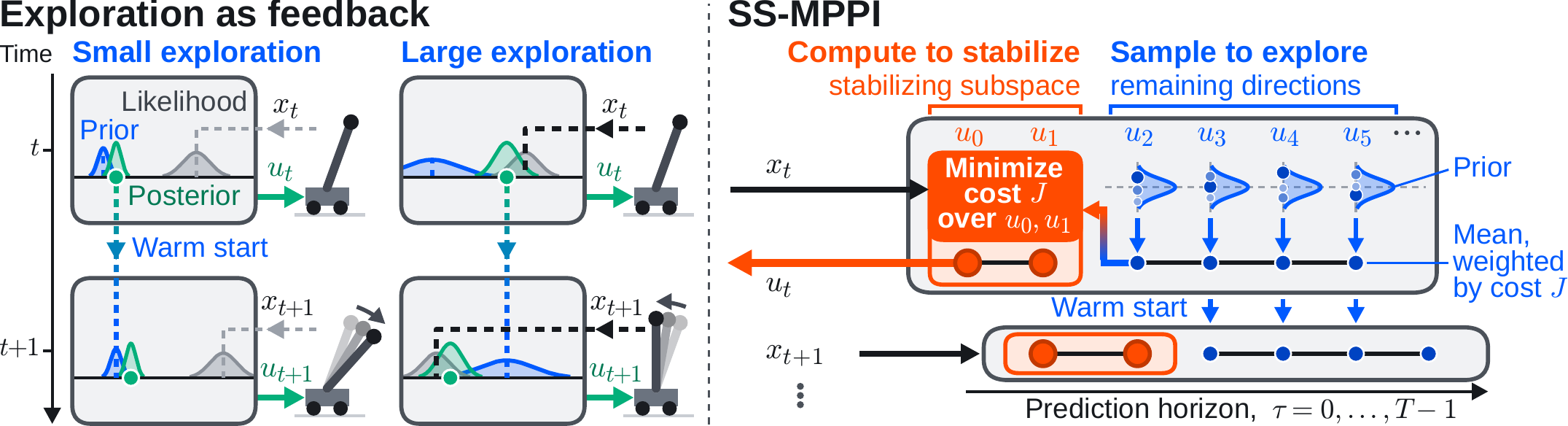
With a warm start, MPPI samples control sequences around the previous solution. The exploration covariance then determines how strongly MPPI corrects the previous solution in response to the current state. Stabilizing Subspace MPPI (SS‑MPPI) computes the control inputs required for stabilization and samples only the rest.
Small Exploration Destabilizes MPPI
An inverted pendulum on a cart at the exploration variance 0.01,
below the stability threshold 0.033 of MPPI.
MPPI and CoVO‑MPC fall, and SS‑MPPI keeps the pendulum upright.
Walking on the Unitree Go2
Unitree Go2 commanded to walk at 0.5 m/s,
with the same samples and exploration variance for every controller.
SS‑MPPI Needs Few Samples
With 16 samples, MPPI slows down, and SS‑MPPI keeps its pace.
Over five seeds, MPPI covers 2.56 m in 12 s and SS‑MPPI covers 4.77 m.
SS‑MPPI with 16 samples walks farther than MPPI with 1024 samples.
How Stabilizing Subspace MPPI Works
SS‑MPPI computes the first inputs of every sampled plan
by one Gauss–Newton step and samples the rest.
In the video, the computed inputs are orange and the sampled inputs are blue.
Beyond the Paper: Walking at 1.5 m/s
The Go2 commanded to walk at 1.5 m/s with the same controllers.
Results
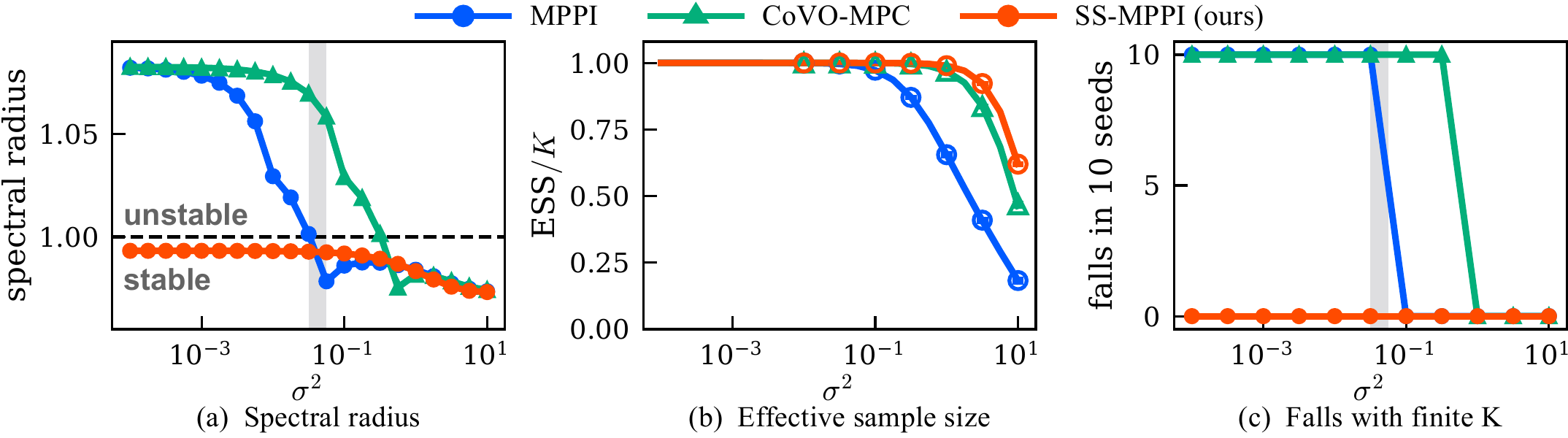
and CoVO‑MPC moves the threshold to 0.33. SS‑MPPI is stable at every tested variance.
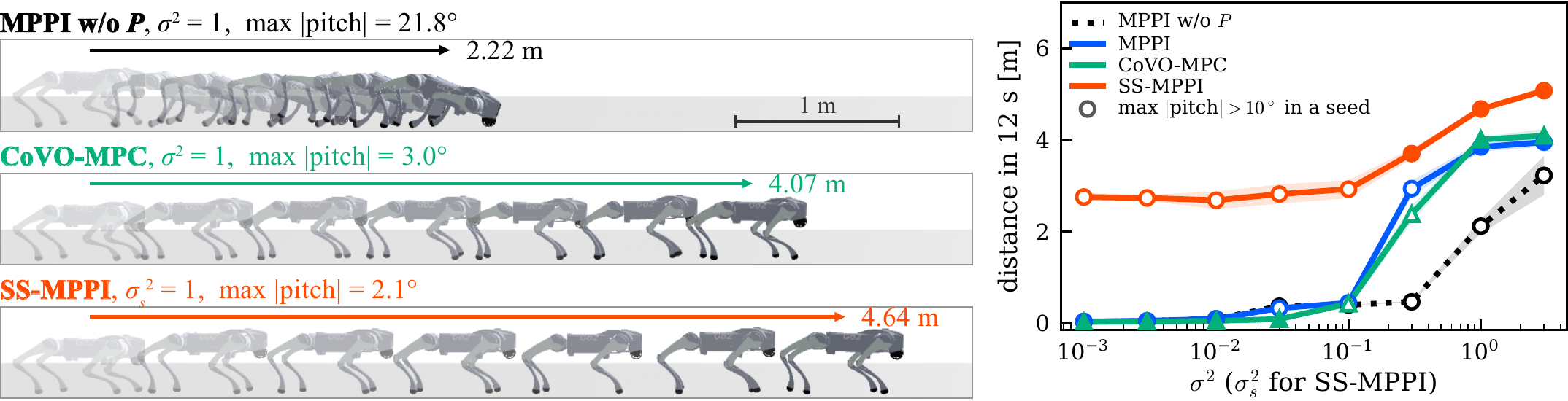
SS‑MPPI walks at every tested exploration variance and covers up to 5.1 m in 12 s.
BibTeX
@misc{ito2026exploration,
  title         = {Exploration as Feedback in Model Predictive Path Integral Control},
  author        = {Ito, Junsei and Honda, Kohei and Wasa, Yasuaki},
  year          = {2026},
  eprint        = {2611.19252},
  archivePrefix = {arXiv},
  primaryClass  = {eess.SY},
  url           = {https://arxiv.org/abs/2611.19252}
}
Acknowledgments
This work was partially supported by the Japan Science and Technology Agency (JST), ACT-X, Grant No. JPMJAX25C3 and JST Moonshot R&D Program Japan Grant No. JPMJMS263D.